The Center for American Progress (CAP) has released a report titled "Fulfilling the Promise of Concentrating Solar Power" where the institution "details why the United States should invest in concentrating solar power and delineate the market and regulatory challenges to the innovation and deployment of CSP technology".
Fortunately, the CAP states that CSP is "a proven energy technology with a 30-year track record". This can sound as an obvious fact for many of us, but there are still a lot of people who think CSP has just been invented and it's yet an immature technology, or at least, that is what some other reports try to make you believe.
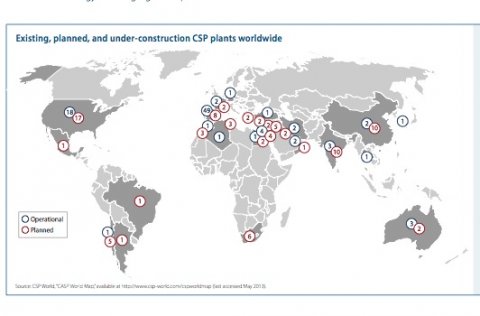
The report analyzes the current status of CSP, especially in the US, where "concentrating solar power is experiencing a resurgence domestically". Currently, there are roughly 1.3 GW under construction to be added to the about 500 MW in operation nowadays.
Regarding costs and employment, the report highlights that "CSP plants are more capital intensive than traditional fossil-fuel plants; their installation is quick but expensive. Once online, however, CSP plant operating costs are extremely low since sunshine is free. Investments in CSP plants therefore produce higher economic benefits in terms of jobs created per unit of built capacity than conventional electricity-generation technologies".
An interesting approach is the comparison of CSP with Carbon Capture and Storage (CCS). The paper cites McKinsey & Company to claim that CSP "will be a much more cost-effective way to generate carbon-free electricity than coal with CCS. Using very conservative assumptions, McKinsey predicts that by 2015 it will be 3 times more expensive to sequester 1 metric ton of carbon from a coal plant than to avoid the emission of the same metric ton of carbon by generating electricity with concentrating solar power".
CAP has found that CSP project developers and the investors who fund them face both market-based and regulatory barriers preventing their technology from achieving the scale of mainstream energy technologies, including 1.- Higher cost of financing, 2.- Unnecessary risk exposure, 3.- No market value of environmental benefits, 4.- Capital intensive compared to fossil fuels, 5.- Regulatory uncertainty and 6.- high transaction costs and Lack of sufficient transmission planning.
Finally, CAP proposes low-cost policy solutions to reduce risk, promote investment, and drive innovation. As Congress and the White House develop separate approaches to combating the deleterious effects of global climate change through energy-policy reform, they should both aim for a few elegant, long-term incentives that will stimulate the CSP industry’s next phase of growth, the report says.
What the CAP proposes
We also offer the following low-cost policy solutions that can reduce risk, promote investment, and drive innovation in the CSP industry:
-
Reducing risk and cost of capital for clean solar energy
- Establish an independent clean energy deployment bank.
- Implement CLEAN contracts for concentrating solar power.
- Reinstate the Department of Energy Loan Guarantee Program.
- Put a national price on carbon.
-
Streamlining regulation and tax treatment of CSP
- Reform the tax code to put capital-intensive clean technologies on equal footing with fossil fuels.
- Guarantee transmissions grid connection for concentrating solar power and other solar projects.
- Stabilize and monetize existing tax incentives.
- Streamline the regulatory approval process by creating an interagency “onestop shop” for concentrating solar power and other clean energy power-generation facilities.
- Ensure long-term regulatory transparency.
This report is available at our CSP Library.
 Printer-friendly version
Related news