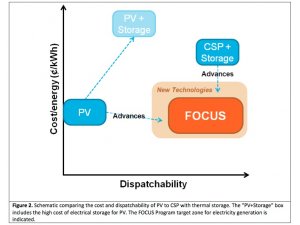
Is it possible to mix Photovoltaics, Concentrated Solar Power and Energy Storage systems to create a disruptive new solar energy conversion and storage technology?, people at ARPA-E think so and have released a new funding opportunity to work in this regard, the FULL-SPECTRUM OPTIMIZED CONVERSION AND UTILIZATION OF SUNLIGHT (FOCUS) will award up to $30 million for research in this aim.
"The overarching objective of the FOCUS Program is to create disruptive new solar energy conversion and storage technology options that enable far higher penetration of solar energy into the U.S. energy system than could be expected using only today’s PV, CSP and electrical storage options". This is the description of the program objectives stated in the papers just released.
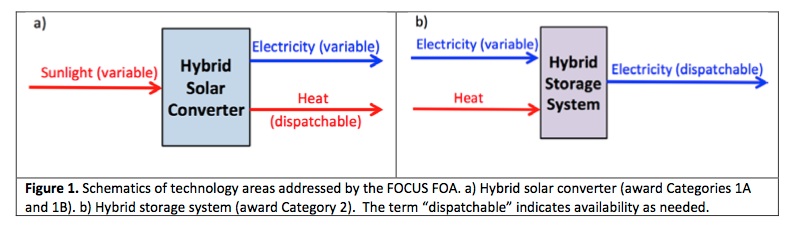
Technical pathways to this goal include: 1) concentrating hybrid solar energy converters that optimize the utilization of the entire solar spectrum by inexpensively converting sunlight to both heat and electricity; and 2) inexpensive hybrid energy storage devices that require both electricity and heat as inputs, with electricity as the output. At technology maturity, energy systems incorporating these advanced converters and storage devices will be cost-competitive with other solutions: for example, electricity projects at utility scale will make dispatchable solar electricity competitive with conventional generation.
A subsidiary objective of the FOCUS Program is to form a diverse research community (including, e.g., CSP mechanical engineers, PV semiconductor materials and device scientists, optics/photonics experts, chemists, low-cost manufacturing experts and system integrators) who will innovate together. Successful FOCUS projects will reduce energy-related emissions, decrease U.S. dependence on foreign energy sources, and provide U.S. leadership in advanced solar energy technology.
The program includes two categories of awards, the first will seek new hybrid solar converter technologies to provide both heat, which can be stored at low-cost for later use, and electricity. The second is for new hybrid storage technologies that can leverage the simultaneous availability of both solar electricity and heat to dispatch solar electricity whenever needed.
The devices and technologies that emerge from the FOCUS Program have the potential to go beyond photovoltaic, concentrating solar power and electricity storage paradigms, to dramatically increase the penetration of solar energy into the U.S. energy mix.
The program highlights in its motivation chapter that "despite the impressive technology and deployment advances made by solar photovoltaics (PV), today’s high-cost electricity storage options will likely limit PV penetration to less than about 5% of U.S. primary energy before significant PV curtailments will be needed at times of high solar availability. 3, 4 Meanwhile, concentrating solar power (CSP), solar heating and solar hot water applications together contribute less than 0.1% of U.S. primary energy, and their deployment is growing only slowly. The primary goal of this FOA is to provide disruptive new solar conversion and storage technology options to enable much higher penetration of solar energy generation into the U.S. energy mix".
"Today’s PV and CSP solutions alone cannot provide the combination of low LCOE and dispatchable output that will be required to enable large-scale solar energy utilization outside daytime hours", the paper says. To succeed, multidisciplinary efforts must develop innovative technologies based on advanced ideas from CSP, PV, storage and other technologies. However, there is scant history of joint work between separate PV and CSP communities that are mainly comprised of scientists and engineers with little overlap in their training and fields of interest. A secondary goal of the FOCUS Program is to promote collaborations among diverse communities of researchers to develop systems that generate inexpensive dispatchable solar energy.
Finally, ARPA-E has noted a significant barrier that slows the development of current solar power systems with storage capability: new thermal solar plants have extremely high capital costs, often in the billion dollar range, driven by economies of scale in turbines and field construction, as well as the fixed costs of planning and permitting CSP systems. Only about 100 CSP plants are installed worldwide,16 sharply limiting technology trials and learning cycles. While innovation in utility-scale solar generation remains its central goal, the FOCUS Program also provides opportunities to develop smaller hybrid solar converters and storage systems that can be deployed in lucrative entry markets. Such entry markets enable increased R&D, stimulate mass manufacturing of system components and allow for rapid learning by engineering design iteration all keys to rapid technology improvement and energy-significant deployment.
 Printer-friendly version
Related news